Why I Am Missing Catherine O'Hara
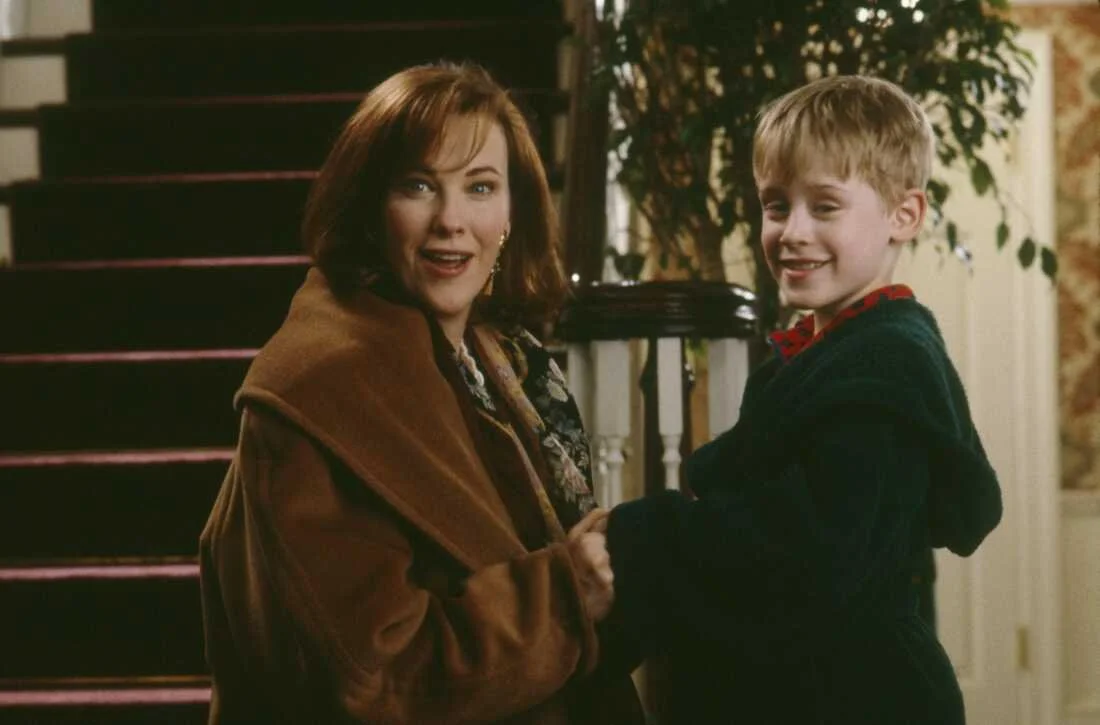
Credit: NPR
When I first moved to New York in the fall of 2012, I worked the table of a yet-to-be-constructed Blink Fitness on 40th Street and Third Avenue. After taxes and transportation costs, I was making $6.20 an hour.
My job was to lock eyes with any unfortunate passerby, smile with the mortal power of a hypnotizing snake, and lure them into our storefront, which looked like a FEMA shelter. I’d tell them all about the promotion we were running – my hands circling like the Greatest Showman – and exhort them to act fast, for this promotion would end soon as the gym opened. When people asked to see the gym in progress, I replied that they would have to wear a hard hat and sign several waivers (no one went for this). When people asked how I could be so sure the gym would be great, I promised them, with all the wattage of my 22-year-old smile, that it would be worth it.
My favorite person from this job was a chap I’ll call William. William was 53 and something of a gentleman Peter Pan, his waifish years still visible in his elegant WASP frame. Since most actual New Yorkers were not dumb enough to work for $6.20 an hour, this outlet was often short-staffed, and William, a regional manager, would occasionally join me in the uninsulated foyer. Every day, he arrived with a different newspaper or magazine: The New York Times, The Hartford Courant, GQ. I asked him if he subscribed to any of these, and he laughed.
“Lord no, that would ruin the day’s surprise.”
Today, inspired in part by William, I decided to leave my apartment in Astoria to buy a fresh paper from a newsstand somewhere in Manhattan. The deeper impulse was that Catherine O’Hara died yesterday, and I wanted to commemorate her in some small, hopelessly consumerist way.
It’s a curious thing to mourn the death of a famous person. I first learned about the news around 1:30pm while working at home. My husband texted me from the opposite side of the work wall we share: “Omg Catherine O’Hara died??” I was just surfacing from a deep writing session and had vowed not to check my phone until that afternoon. I was all peaceful and feeling like myself when I checked my phone. In 20 seconds, I was distorted by a cascade of terrible headlines: more innocents murdered, more criminals growing in power. And now the death of Catherine O’Hara?
I replied: “is this real?”
For several moments, I hoped against all reason that it was a hoax, not unlike Moira Rose’s fake death report in Schitt’s Creek. But there was the NYT headline, dead at 71. I wrote my husband back: “No no no no no.”
When we’re deeply impacted by news, it’s only human to wish to share it, so I reposted the headline announcing her death, with a caption conveying my exact sentiment: “I regret checking my phone.”
The first responses mirrored my own: “NOOOO” and “nooo!!!” and “Nooooooooo.”
By the second hour, variations of the crying emoji.
By the third hour, swapping stories of comedy’s favorite mother. And today, memes of her Beetlejuice dance, her speech to Macaulay Culkin, responding to a fan at the airport who asked what role she’d like be remembered for: “Mother of my children.”
What gets me is the initial, visceral response so many of us had to the news of Catherine O’Hara’s passing. Many of us said — No. What a testament to the impact she had on others. When an artist helps trace the full amplitude of our humanity, their presence and vision cannot be forgotten.
And that No — just what were we railing against?
Catherine once told Variety: “There’s no better survival instinct. You’re so lucky if you’re raised with it. It’s one of God’s greatest gifts, because life is full of the dark and the light. You gotta look for the light.”
That’s what we are missing right now, that comic grin toward the light. Catherine understood that all we can do is make our tiny corner of the universe a little more beautiful. That’s how I’ll remember her. That’s why so many people (Seth Rogan, Pedro Pascal) reach for the word “lucky” when describing their relationship to her comic genius. That message of finding beauty and happiness in whatever small plot of land you find yourself on — what a gift.
***
The McNally Jackson at 47th Street did not carry The New York Times. The Barnes and Noble at 45th Street no longer sells newspapers. I asked a newsstand on 42nd Street and 5th Avenue if they sold newspapers. The newsstand on 42nd and Madison suggested Grand Central.
What a crazy time we’re living in. Newsstands no longer offer the news.
I found myself feeling sorry for William from Blink Fitness, who, if he still called New York home, would be in his mid-60s.
***
Another reason why O’Hara’s passing feels like such a gut punch is that it connects to all the goodness we’ve been shown and the ones who gave it: mothers, teachers, guardians, friends. The singer Michael Bublé wrote, “She made the world laugh, but she also made people feel seen.” Her passing is like a hit to the limbic system, that memory factory in the brain that stores the hippocampus and influences emotion. The limbic system is like a wind chime: a hit to one tube will inevitably produce vibrations through the neighboring chimes.
O’Hara embodied a stanza from “Famous” by Naomi Shihab Nye:
I want to be famous to shuffling men
who smile while crossing streets,
sticky children in grocery lines,
famous as the one who smiled back.
In all the roles I know her from – The Studio, Schitt’s Creek, Beetlejuice, Home Alone, Best in Show – she was the one who smiled back. And I cannot think of Catherine O’Hara without remembering eating popcorn with my abuela and watching Home Alone 2: Lost in New York, or cackling at Best in Show with my mother, and the DVD copy I failed to return to the library for nearly a year.
Each of them is gone now. Of course, their memory lives on through me. My mother and abuela remain as vivid to me as Catherine O’Hara screaming “KEVIN.”
***
It does feel like the end of an era. My friends in their 50s grew up with SCTV (Second City Television). Because of Catherine, they became actors, writers, directors. As a millennial, she was a comic force, yes, but also a stabilizing one; she was Kate McCallister walking through the Plaza back when a deranged narcissist was a passing joke and not hijacking the White House. When people reacted to O’Hara’s death with This can’t be real, they were also talking about America’s fall to autocracy, a new society where humans are expendable, judges and journalists are arrested for doing their jobs, citizens are murdered for protesting blatant abuse of force, and five-year-olds are used by masked vigilantes as “bait.” It can’t be real. Not in this moment. Not when we clearly need more joy.
Catherine O’Hara’s death is difficult to process because it coincides with the growth of a new society eager to deploy fascist politics. Words have been robbed of meaning. Lies are the norm. Newsstands no longer sell newspapers.
***
I did end up finding a copy of The New York Times in Grand Central Station. I imagine that I don’t have to tell you how depressing it was to discover that the only place I could buy an obituary of Catherine O’Hara was at Hudson News. Like these outlets, Hudson News was bright and depersonalized, a space interchangeable at any airport or train station around the world. It felt like a militarized zone, which was especially true at Grand Central, where military personnel routinely roam its tunnels. There was no bodega cat. Any fresh book or paper smell had been sterilized. It struck me then that I no longer had access to an old habit of life — the simple, spontaneous choice to buy a newspaper.
I have yet another twist for you: I did not buy a copy of The Times today. The front page was of an FBI raid in Atlanta, part of Trump’s attempt to claim the 2020 election was “stolen” — a front page I do not need to commemorate. O’Hara did make the front page, but the bottom centerfold, and that is simply not how we should remember a queen.
So, after all this walking, I didn’t find a cover memorializing Catherine O’Hara (or at least one I could stomach). I flipped through some Harvard Business Review books, was tempted by Bad Bunny on People, then thought I could purchase some collectible about her life from US Weekly whenever that comes out. Somewhat at peace with this brave new world, I left. But not before buying a $5 copy of Financial Times because I like the off-pink color and they had an essay by Marilynne Robinson.
Of course, you would be right to criticize me for patronizing FT. For not giving the $5 instead to an unhoused person I passed in the subway, to buying paper at all when the world is on fire, for not donating that money to any candidate who can resist fascism, for giving money to a chain bookstore rather than an independent, for using the self-checkout aisle instead of the clerk, for supporting a business-oriented magazine that is probably not much better than The Post. I criticize myself constantly, even as I continue to live in my own fucked up, assertively non-saint-like way.
Many of O’Hara’s characters were, by turns, wicked, hilarious, compassionate, self-aggrandizing, keen, mean, and surprising. I think we found relief in them because they saw our complexity; their examples allowed us to be our joyful, ribald, clueless, courageous selves. They seemed to hold that the world is messy, and we are no different.
I will miss knowing that a star like Catherine O’Hara is alive in this world. But like millions of others, I am grateful for the world she gave us. She made us laugh. She made us smile.